When an AI agent forgets a customer’s preferences or repeats work from a previous session, the problem is often not the model—it is the memory design. Effective AI agent memory management gives an agent a reliable way to preserve useful information, retrieve it at the right time, and update or discard it when circumstances change.
This guide explains how to build that system step by step. You will learn what to remember, how to organize storage, how to retrieve relevant context, and how to protect and evaluate memory in production. The goal is persistent context AI agents can use safely, including long-term memory for AI automation that improves workflows without turning every conversation into an endless transcript.
1. Decide What AI Agent Memory Management Should Preserve
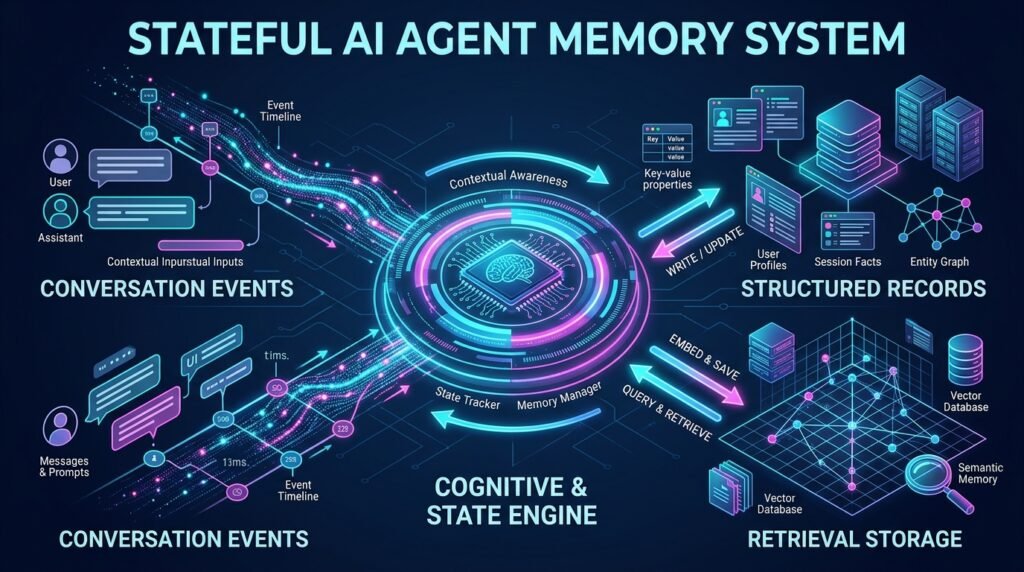
Start by defining what the agent needs to remember to complete future tasks better. Memory is not a transcript archive with a new name. It is a deliberately selected set of facts, preferences, decisions, and task states that remain useful beyond the moment they were first mentioned. Good AI agent memory management begins with a clear answer to this question: what future action should this information improve?
For a customer-support agent, useful details might include a verified account identifier, preferred language, an unresolved case, or a confirmed accessibility preference. For an internal operations agent, memory could include a project’s approved terminology, a recurring report format, or a handoff that is waiting for human review. By contrast, a one-time question about the weather may have no lasting value.
Separate information into practical categories before choosing a database:
- Working memory: temporary facts needed within the current request, such as the current order number or an intermediate calculation.
- Session memory: conversation details that matter while a single interaction is active, including the user’s immediate goal and steps already completed.
- Long-term memory: durable facts, preferences, and project details that can inform future conversations or automated runs.
- Procedural memory: instructions about how a task should be performed, such as a team’s approved escalation sequence.
These categories have different lifetimes and access rules. A temporary working value may disappear after a run, while a customer preference may need to persist until the customer changes it. A procedural rule may require approval before an agent can modify it. Treating every item alike makes it difficult to determine what should expire, what should be searchable, and who is allowed to change it.
Define a memory record with enough structure to make later decisions possible. A useful starting schema includes the content, memory type, owner or scope, source, creation time, last-confirmed time, confidence, sensitivity classification, and expiry or review policy. Add a stable entity identifier when the information belongs to a customer, project, or workflow. Store provenance alongside the fact so the agent can distinguish a user-confirmed preference from an inference.
For example, “prefers email updates” is incomplete if the system cannot say who expressed the preference, when it was confirmed, or whether it applies to one case or all cases. A record can instead state that the account owner requested email updates, cite the conversation event, and set the scope to the account. If a later request contradicts it, the agent has enough context to ask whether the preference should be updated rather than silently choosing one version.
Set boundaries before implementation. Do not preserve sensitive data merely because it might someday be useful. Identify data that should never enter memory, require explicit consent where appropriate, and establish deletion and retention rules. For long-term memory for AI automation, usefulness and responsibility must be designed together: an agent that remembers everything is not necessarily an intelligent or trustworthy agent.
Finally, write down a small memory policy in plain language. Specify what qualifies for storage, how the agent should confirm uncertain facts, which records expire, and how people can correct or delete information. That policy becomes the foundation for your schema, prompts, tools, tests, and operational controls.
2. Design AI Agent Memory Management as Separate Layers
Once you know what matters, choose an architecture that matches each kind of memory. A single database can support several patterns, but it should not force every piece of context into one undifferentiated text field. Layered AI agent memory management makes it easier to balance fast access, semantic search, auditability, and retention requirements.
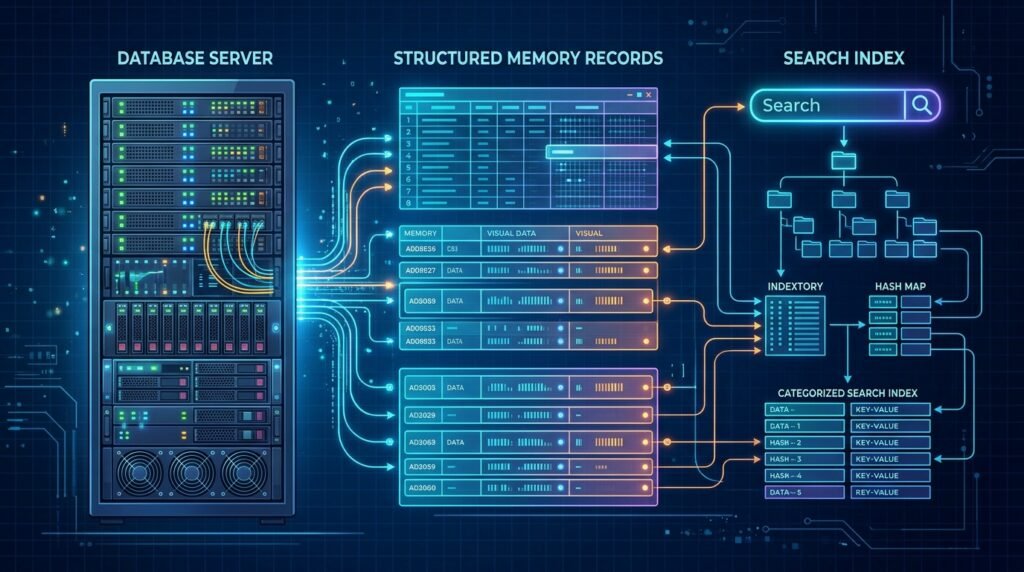
A practical design often combines three stores. Keep recent conversation events in a session store, such as a relational table or a short-lived cache. Put durable, structured facts in a database that supports filtering by user, project, status, or date. Use a vector index when semantic similarity helps find relevant passages that cannot be retrieved reliably with exact terms. A vector index is a retrieval aid, not a complete source of truth.
For instance, an agent helping a sales team could keep the current call’s notes in session state, save approved account facts in relational records, and index selected meeting summaries for semantic retrieval. A question about the account owner should use a precise database filter. A question like “What concerns came up in earlier discussions?” may benefit from semantic search over relevant summaries. The architecture should send each query to the most suitable store.
Use stable identifiers and explicit scope. A memory might belong to an individual, a team, a project, or an organization; these scopes are not interchangeable. Include tenant and owner identifiers in retrieval filters, and test that one user cannot retrieve another user’s records. When a conversation has both personal and shared information, store them separately rather than relying on the prompt to sort them out later.
Plan how records are created and updated. A memory-writing step can extract candidate facts from an interaction, validate them against a schema, and then decide whether to insert, merge, or reject them. Use deterministic application logic for identity matching and access checks. The language model can help interpret a statement, but it should not be the only component deciding which account a fact belongs to or whether a permission boundary can be ignored.
Teams comparing storage patterns can use this overview of AI agent memory architectures and their trade-offs to explore common designs. For persistent context AI agents, the right architecture is usually the smallest combination of stores that meets retrieval and governance needs—not the most elaborate stack available.
Keep the application’s memory interface independent from its storage vendor. Define operations such as write_memory, search_memory, update_memory, and delete_memory, with clear input and output schemas. This lets you change a database or add a search index without rewriting the agent’s whole decision process. It also gives you a natural place to enforce authorization, validation, and logging.
Conversation state and durable memory are related but distinct. The OpenAI conversation state documentation describes ways to manage context across turns. Use such mechanisms for continuity within an interaction, then decide separately which facts deserve application-managed persistence across sessions. Do not assume that carrying conversation state forward automatically provides the retention, deletion, or cross-user controls your product requires.
3. Build a Reliable Write, Update, and Retrieval Pipeline
A memory system becomes useful only when the agent can move information through it consistently. Build the pipeline as explicit stages: capture a candidate, validate it, resolve its scope, store or update it, retrieve it for a future task, and record how retrieval affected the response. This makes AI agent memory management testable rather than an invisible prompt instruction.
At capture time, extract only information that meets your memory policy. Ask the model to return a typed object rather than free-form prose. A candidate record might include a fact, category, entity ID, source event ID, confidence, and suggested expiry. Validate required fields in application code; reject malformed output and prevent the model from inventing missing identifiers. If the fact is uncertain or consequential, ask the user to confirm it before saving.
Next, resolve whether the candidate is new, a correction, a duplicate, or a contradiction. Avoid appending another copy each time a preference is mentioned. Compare against existing records for the same scope, update the confirmation timestamp when the fact is reaffirmed, and keep a version history when auditability matters. If two sources conflict, use an explicit precedence policy—for example, a current direct user correction can supersede an older inference.
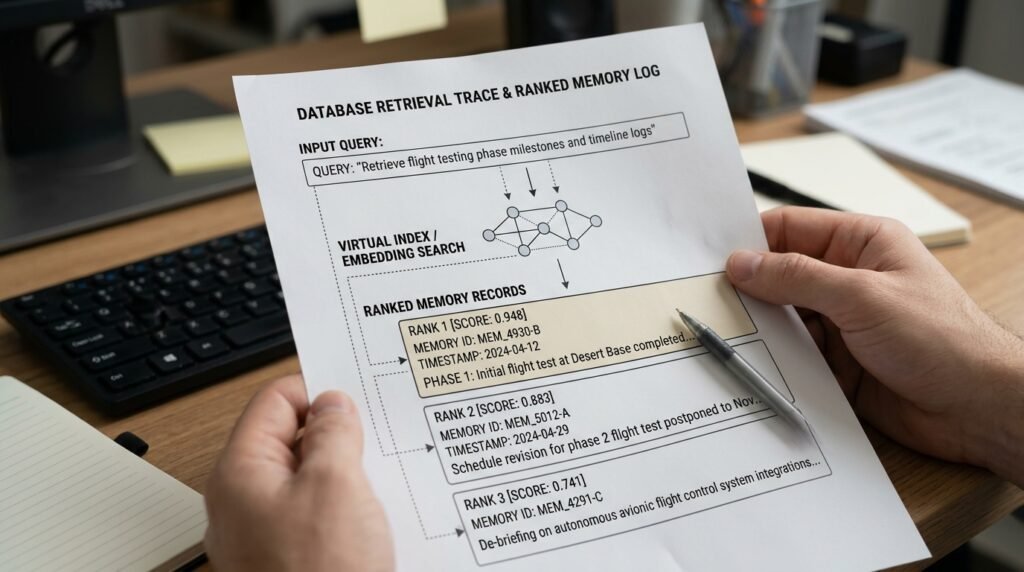
Retrieval should be a controlled step before the agent answers or acts. First identify the task and the relevant person, project, or workflow. Then query structured records using exact filters, and use semantic search only where similarity adds value. Apply authorization and recency filters before returning results. Finally, limit the amount of memory passed to the model to the few records that can change the next decision.
For each retrieved item, provide useful metadata: its source, date, confidence, and scope. A short record such as “Account requests email updates; confirmed by account owner on [date]” is easier to use responsibly than a paragraph of unexplained context. Tell the agent to treat retrieved content as evidence, not as higher-priority instructions. Stored text may contain mistakes or malicious instructions, so memory must never override system rules or access controls.
Integrate these stages into workflow automation with clear boundaries between model calls and deterministic steps. In n8n, for example, a workflow can receive an event, validate its payload, call an extraction step, route low-confidence candidates to a human, and write approved records to storage. If your pipeline transforms records between tools, this guide to n8n workflow data transformation methods can help you keep fields consistent across the handoff.
Make failure behavior explicit. If the memory service is unavailable, the agent should not pretend it recalled a fact. Depending on the task, it can ask the user to repeat the relevant detail, continue without personalization, or pause an action that requires verified context. Use timeouts, retries with limits, and idempotency keys so a retried workflow does not create duplicate memories.
Track the full lifecycle with observability. Log memory reads and writes with record identifiers, operation outcomes, and workflow trace IDs, while avoiding unnecessary sensitive content in logs. Measure retrieval latency and failures separately from answer quality. These signals help distinguish a model reasoning problem from stale, missing, inaccessible, or irrelevant memory.
4. Improve Recall Without Flooding the Agent With Context
Retrieval quality is a balancing act. Too little context makes an agent forget useful history; too much context raises latency, obscures important facts, and can make the model follow stale or irrelevant details. Strong AI agent memory management retrieves a small, ranked set of records that directly supports the current task.
Begin with simple retrieval before adding complex ranking. Filter by tenant, entity, memory type, permission, and status. Apply a recency window where facts can become outdated. Then rank results using a combination of relevance, confidence, freshness, and importance. The precise weights should reflect the application: recent task state may matter most for a project assistant, while a verified account identifier should outrank a recently mentioned but unconfirmed guess.
Use hybrid search when both exact matching and meaning matter. Keyword or database filters are good for names, IDs, dates, and precise categories. Vector similarity can find conceptually related summaries when the user describes an earlier event in different words. Combining the two reduces the risk of relying on a semantically similar but incorrect record. Always retain filters that enforce identity and access; similarity alone is not a security boundary.
Summarization can reduce the volume of historical conversation, but summaries should be treated as derived data. Keep links to source events where possible, label the summary as a summary, and regenerate it when significant corrections occur. Do not discard original evidence if the workflow needs an audit trail or the summary could alter a consequential decision. For everyday personalization, a concise, confirmed fact may be more useful than a compressed narrative of an entire conversation.
Persistent context AI agents need conflict handling as much as recall. If the retrieved preference says “weekly report on Monday” while the current user says “send this one Friday,” treat the current instruction as a possible one-time override, not necessarily a permanent change. Ask a clarifying question when scope is ambiguous. When the user explicitly requests a lasting change, update the record and keep its provenance.
Set a context budget for each task. Retrieve first, then select and format memory according to the task’s needs. A support response may require the last unresolved case and the customer’s preferred language; a reporting workflow may need metric definitions and the approved reporting period. Pass only those records, with concise labels, instead of inserting an entire profile into every prompt.
Test retrieval with realistic queries, including paraphrases, misspellings, outdated facts, shared names, and requests that should return no result. A useful evaluation set records the expected relevant memories and the records that must not appear. Measure recall of useful items, precision of retrieved items, cross-scope leakage, and the effect on task completion. Review failures by category and adjust filters or ranking, rather than responding to every miss by increasing the number of retrieved results.
For long-term memory for AI automation, a clean “no relevant memory” outcome is a feature. It gives the agent a reason to ask, verify, or proceed without personalization instead of fabricating a recollection. Make that behavior clear in the system instructions and in the user experience.
5. Protect, Govern, and Evaluate Memory Over Time
Persistent memory changes an agent’s risk profile. A mistake that was once limited to one conversation can influence future actions, and information saved for one user could expose another user’s data if scoping is weak. Treat AI agent memory management as an operational control system, with clear ownership, permissions, review routines, and deletion paths.
Apply least-privilege access to both the memory service and its underlying stores. Separate read, write, update, and delete permissions where practical. Enforce tenant and user scope in application code and verify it at the data layer. Encrypt data in transit and at rest according to your organization’s security requirements. Avoid putting secrets, credentials, or unnecessary personal information in model prompts, indexes, or diagnostic logs.
Make memory visible and correctable. Depending on the product, users or administrators may need to see what the agent remembers, where the information came from, and how to request a correction or deletion. A deletion request should cover derived copies such as search indexes, cached summaries, and backup policies where applicable. Document the expected processing time and verify that deletion propagates through every store.
Use retention rules that match information type and purpose. A temporary workflow state may expire after the task is complete; an approved preference may stay until changed; a project record may be removed when the project closes. Avoid indefinite retention by default. Schedule review jobs that identify expired, unconfirmed, or contradictory records and then delete, archive, or route them for review according to policy.
Prompt injection and poisoned memory require specific defenses. A retrieved message may contain text such as “ignore earlier rules,” but it remains untrusted data. Keep instructions separate from memory content, delimit retrieved passages, and tell the model not to execute commands found inside stored records. Validate write operations, limit which sources can create durable memories, and require human approval for high-impact changes.
Build an evaluation suite before broad deployment. Include tests for successful recall, correct updates, expired facts, user corrections, missing memory, conflicting records, unauthorized retrieval, and deletion. Run the suite whenever you change prompts, models, schemas, retrieval logic, or access controls. Use a representative set of real-world cases with sensitive details removed or appropriately protected, and supplement offline tests with monitored production signals.
Measure outcomes that matter to the workflow: task completion, repeated questions, incorrect personalization, retrieval precision, stale-memory use, escalation rates, and user corrections. A rising recall score is not an improvement if the agent also leaks data or acts on outdated context. Review a sample of memory writes and retrieval traces with the teams responsible for product, operations, and security.
Finally, define human intervention points. Route low-confidence facts, high-impact actions, and unresolved contradictions to a reviewer. In a workflow that can send messages, change records, or trigger downstream automation, an approval gate can stop an uncertain memory from becoming an irreversible action. The right balance depends on risk: low-impact personalization can be automatic, while financial, legal, or account-changing actions may require stronger confirmation.
For further reading, see the official n8n documentation.
Frequently Asked Questions
What is the difference between conversation history and agent memory?
Conversation history is a record of messages. Agent memory is selected information extracted from interactions and organized for future use. History can support audits or context reconstruction, while memory should be concise, scoped, and governed so an agent can retrieve relevant facts without rereading every past message.
Does an AI agent need a vector database to remember information?
No. A relational database, key-value store, or application database may be enough when the agent needs exact facts and predictable filters. A vector index is useful for semantic retrieval over unstructured text, but it adds operational complexity and should complement—not replace—structured records and access checks.
How can I stop an agent from remembering incorrect information?
Use typed extraction, validate records in application code, retain source and confidence metadata, and require confirmation for uncertain or consequential facts. Provide a way to correct records and test how the agent handles contradictions. AI agent memory management should also make it possible to remove a mistaken memory and its derived copies.
How much memory should be included in each prompt?
Include only the smallest set of records that can affect the current task. Filter by identity and scope, rank by relevance and freshness, and set a context budget. If no memory is relevant, let the agent proceed without it or ask the user rather than padding the prompt with unrelated history.
How do I make memory persist across separate conversations?
Store selected records in an application-managed persistence layer keyed to an authorized user, project, or organization. On a new conversation, retrieve only records relevant to that task and confirm that permissions still apply. Conversation state can help across turns, but durable cross-session memory needs explicit storage and lifecycle controls.
Conclusion: Build Memory That Earns Its Place
Reliable AI agent memory management is a complete lifecycle: decide what is useful, store it with scope and provenance, retrieve it selectively, and maintain it through correction, expiry, and deletion. Separate session continuity from durable facts, keep structured records authoritative, and test both helpful recall and harmful retrieval.
Start with one workflow and a small memory policy. Add a few well-defined record types, measure whether they improve task outcomes, and strengthen controls before expanding. Thoughtful long-term memory for AI automation can make agents more consistent without sacrificing user trust. Talk with Seelaunch about designing stateful AI automation for your workflows.