

Enterprise automation rarely fits inside one workflow. A customer request might trigger validation, enrichment, approval, fulfillment, and notification across several systems. When those steps live in separate n8n workflows, the design must make ownership, handoffs, and recovery explicit. That is the purpose of n8n workflow orchestration patterns: organizing connected workflows so each can evolve independently without making the overall process fragile.
This guide explains how to choose workflow boundaries, coordinate synchronous and event-driven work, share state safely, and operate a distributed automation architecture. The examples use a fictional order process, but the same methods apply to onboarding, finance operations, IT service management, and other enterprise processes.

Choose n8n workflow orchestration patterns around clear ownership
Start by defining what each workflow owns, not by splitting a large diagram wherever it looks crowded. A workflow boundary should represent a meaningful capability, such as validating an order, reserving inventory, or issuing a refund. That capability should have a clear input contract, a defined outcome, and one owner responsible for changes. This is the foundation for n8n workflow orchestration patterns that stay maintainable as teams, integrations, and execution volumes grow.
For example, an order process could have a parent workflow that receives the order event and calls child workflows for fraud review, inventory reservation, and customer communication. The parent owns the overall business sequence. Each child owns its specific task and reports a concise result, such as approved, rejected, or needs_review, along with relevant identifiers. Avoid returning entire API responses when a few stable fields will do.
In n8n, the Execute Sub-workflow node is useful when a parent needs to invoke a reusable workflow and receive its result. Choose whether the parent waits for the child to finish based on the business requirement. Waiting is appropriate when the next decision depends on the result; it is less appropriate for long-running tasks that can proceed independently. Review the official n8n sub-workflow documentation for the available configuration and input options.
Write the contract before building the connection. Document the required fields, optional fields, response shape, expected duration, and error behavior. Include a correlation ID so an operator can trace the parent execution and all related child executions. Version the contract when a change would break a caller, and make consumers tolerant of additional optional fields where practical.
A useful rule is to keep tightly coupled decisions together and split work that has an independent lifecycle. If one step cannot be tested, deployed, or retried without understanding every other step, the boundary may be too fine. If a single workflow has many branches owned by different teams, or requires unrelated credentials and release schedules, the boundary may be too broad. These multi workflow coordination strategies should reduce coupling, not merely increase the number of workflows.
Keep a workflow catalog with each workflow’s owner, purpose, trigger, inputs, outputs, dependencies, and criticality. Use descriptive names that distinguish reusable capabilities from process-level coordinators. A short architecture record can explain why a workflow is a sub-workflow, webhook consumer, or scheduled worker. This small amount of documentation saves time when a team must change a process months later.
Finally, test each child independently and test the parent-child contract together. For practical coverage ideas, use this n8n workflow testing strategies guide to plan unit-style workflow checks and end-to-end scenarios. A clear boundary is valuable only when its behavior can be verified.
Use n8n workflow orchestration patterns for dependable handoffs
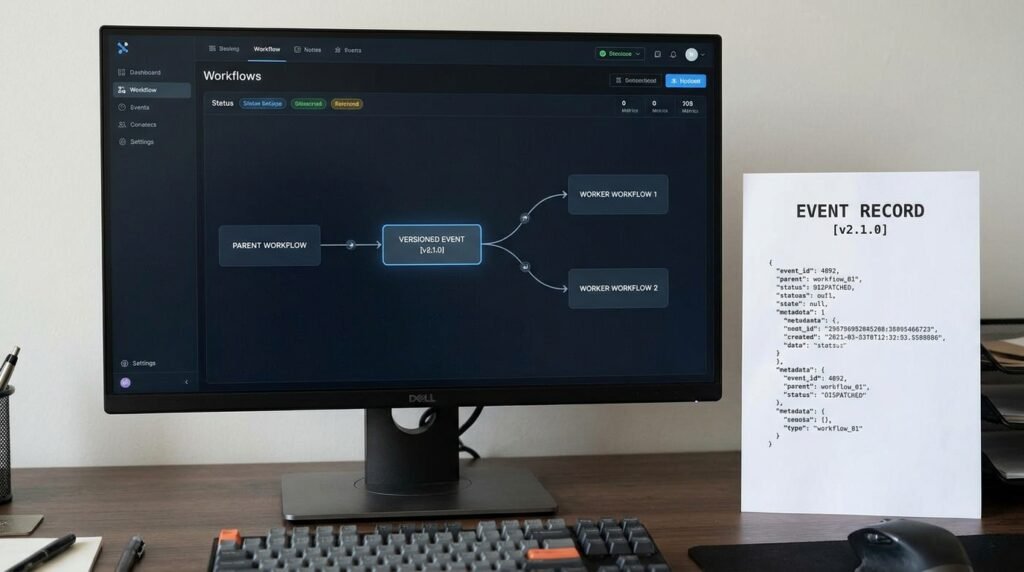
Once workflow responsibilities are clear, decide how they communicate. A direct sub-workflow call is a good fit when the caller needs an answer immediately and the child is expected to finish within a bounded time. An event-driven handoff is better when work may take minutes or hours, can be processed independently, or should not hold an upstream execution open. Choosing deliberately is central to n8n workflow orchestration patterns for enterprise processes.
Consider an order that needs a human review. The intake workflow can save the order as pending_review, send an approval request, and finish. A separate workflow can start from the approval event, validate the decision, update the order, and trigger fulfillment if approved. The handoff is an event containing an order ID, event type, schema version, and correlation ID—not a copy of every field from the original execution.
Every event-driven design needs a duplicate-delivery plan. Webhooks, queues, and retries may deliver the same request more than once. Give each business operation a stable idempotency key, such as orderId:reserveInventory:v1, and record whether that operation has already completed. Before creating a payment, reservation, or ticket, check the key or use an idempotent API operation where the provider supports it. A retry should resume safely rather than create a second business effect.
Define the expected sequence as well as the message shape. If fulfillment must not start before payment authorization, express that dependency in durable state or an explicit event rule. Do not assume that separate workflows will finish in the order they were triggered. For concurrent tasks, record each result and continue only after the required set has completed. Set a deadline for waiting states and provide a path for late, missing, or contradictory results.
For inbound webhooks, acknowledge quickly when the process can be safely queued or handed off, then do longer work in a separate execution. Validate authentication, payload shape, and event freshness before accepting a request. The n8n webhook security guide covers controls that help protect these entry points. For a longer-running integration, use a durable queue or database-backed work record rather than relying on a single in-memory assumption.
These multi workflow coordination strategies involve a trade-off. Synchronous calls are easier to follow and return immediate results, but they increase dependency on availability and can lengthen execution time. Asynchronous messages improve isolation and absorb bursts, but require explicit state, duplicate handling, and monitoring for messages that never complete. Select the simplest option that meets the service-level requirement.
For every handoff, define what happens when the receiver is unavailable, rejects the payload, or returns an unexpected result. Specify retry limits, backoff, and a terminal failure route. Include enough context for an operator to investigate, but avoid passing secrets or unnecessary personal data between workflows. In a distributed automation architecture, communication contracts are operational controls—not just implementation details.
Manage shared state without creating hidden dependencies
Separate executions do not automatically share reliable business state. One workflow’s execution data is not a durable database for another workflow, and passing large payloads through every handoff creates brittle coupling. Choose a system of record for process state, then let each workflow read or update only the fields it needs. This is one of the most important n8n workflow orchestration patterns for processes that span multiple systems or last longer than a single execution.
For a basic order lifecycle, a state record might include order_id, status, version, updated_at, correlation_id, and a small set of milestone timestamps. Keep the record focused on coordination, while leaving detailed customer or financial records in their authoritative applications. The state store might be a relational database or an existing enterprise service, depending on access controls, durability, and operational ownership.
Make state transitions explicit. Instead of allowing any workflow to write any status, define allowed transitions such as received → validated → approved → fulfilled, with documented exception states. A worker should verify that the current state permits its action before updating it. When two workers can update the same record, use a version field or another concurrency control so a stale update does not overwrite a newer decision.
Many processes need a read-modify-write operation: read the current state, decide what to do, then write the result. If two executions can do that concurrently, the sequence may race. Prefer an atomic database update, transaction, unique constraint, or locking approach appropriate to the chosen store. Consult the PostgreSQL documentation on transaction isolation when using PostgreSQL, and involve the database owner before introducing coordination logic into a shared production database.
Be deliberate about what n8n execution data retains. Execution history is valuable for troubleshooting, but it is not a substitute for a business-state model. Apply retention and access rules that fit the sensitivity of the data. If a workflow must resume after a long wait, store the durable business facts it needs and use an explicit resume trigger or scheduled check rather than assuming an old execution contains the complete, current truth.
Define ownership for each field. For example, the payment workflow may own payment_status, while the fulfillment workflow owns shipment_status. A coordinator can combine those values to determine the overall order state, but should not silently overwrite the source of truth. Field ownership limits accidental conflicts and makes audit trails easier to interpret.
These multi workflow coordination strategies also need a policy for missing and stale state. Set a maximum age for pending records, identify which workflow can repair or reconcile them, and log corrections with an actor or reason. Where a business action must be atomic across a database and an external API, acknowledge that a single transaction usually cannot span both systems. Use a durable intent record and a compensating action—such as releasing a reservation if payment fails—instead of pretending the steps are one atomic operation.
In short, a shared state store should make coordination visible without turning every workflow into a tightly coupled database client. Keep schemas small, transitions governed, and state ownership documented. Those decisions make recovery and future changes much safer.
Build recovery and observability into n8n workflow orchestration patterns
Enterprise reliability does not mean that every execution succeeds on the first attempt. It means failures are detected, contained, and recoverable without duplicate business effects. Establish a consistent policy for timeouts, retries, terminal failures, and manual intervention across the workflow network. A dependable design makes these rules visible in the implementation and in the operator’s runbook, rather than leaving them to individual node defaults.
Classify errors before choosing a response. A temporary rate limit or network timeout may be retried with bounded exponential backoff. Invalid input, revoked authorization, or a business rule rejection usually needs correction or review rather than repeated attempts. Set a maximum attempt count and a maximum elapsed time. After that limit, route the work to an error workflow or durable failure queue with the original correlation ID and a concise reason.
Retries are safe only when the action is repeatable or protected by idempotency. If an API request times out after the provider completed it, the caller may not know whether the operation happened. Query the provider using a stable external reference before repeating a high-impact action. For actions that cannot be queried or made idempotent, require a review step and document the risk. The useful measure is not the number of retries but whether a retry can create a second charge, ticket, or shipment.
Use a shared correlation ID from the first accepted event through every child workflow and downstream callback. Include it in structured logs, state records, and alert payloads. Record workflow name or ID, execution ID, business object ID, attempt number, and the transition performed. Avoid logging credentials, full payment details, or unnecessary sensitive payloads. A concise, structured record is easier to search than a copied execution dump.
Monitor business outcomes as well as workflow errors. Useful signals include the number of records by state, age of the oldest pending item, failure rate by workflow, retry volume, and time from acceptance to completion. Set alerts on conditions that require action, such as a growing backlog or an order stuck in review beyond its deadline. Test the alert route too; an alert that nobody receives is not an operational control.
Use a dedicated error workflow to standardize notifications and capture investigation details, but avoid making it a single point of failure for every recovery action. Ensure its own failure is visible through platform monitoring or an alternate channel. For a deeper troubleshooting process, consult the n8n workflow debugging guide. Keep a runbook with steps to inspect state, replay an event safely, and reconcile the external system.
Recovery should distinguish replay from compensation. A replay repeats a failed step after correcting the cause; compensation reverses or neutralizes an earlier successful step when the overall business process can no longer continue. For instance, if inventory is reserved but payment is rejected, a compensating workflow can release the reservation. Keep these actions explicit and auditable, and require human approval for compensation when the consequences are material.
These n8n workflow orchestration patterns are stronger when failure behavior is tested intentionally. Simulate a timeout, a duplicate event, a malformed response, and a temporary downstream outage in a non-production environment. Confirm the state, alerts, retry limits, and final operator instructions. This is how distributed automation architecture moves from a collection of connected diagrams to a service a team can operate.
Scale and govern a distributed automation architecture
Reliability also depends on how workflows are deployed and operated. Before scaling execution volume, measure where the bottleneck sits: workflow concurrency, API limits, database contention, long-running executions, or infrastructure capacity. A larger worker pool does not solve a rate limit or a poor state model. Use load tests with realistic payload sizes and execution patterns, and define the throughput and completion-time targets that matter to the business.
Queue-based execution can help separate incoming work from processing capacity when the deployment and workload justify it. It adds infrastructure and operational responsibilities, so plan for queue health, worker capacity, database performance, and recovery after interruption. Review n8n’s deployment guidance and test the chosen configuration under representative conditions. For infrastructure fundamentals, this n8n self-hosting and Docker scaling guide provides a practical companion. Keep environments and credentials separated so a test workflow cannot accidentally perform production actions.
Set governance standards for names, ownership, credential use, workflow sharing, and change review. Use least-privilege credentials and give each integration only the access it requires. Centralize secrets through supported credential management rather than embedding them in code or workflow data. Define who can publish changes to critical workflows, and preserve a tested rollback path for updates that affect shared contracts.
For versioning, record the purpose and contract changes alongside the workflow release. A new optional field may be backward compatible; changing a field’s meaning or removing it can break downstream consumers. When several teams depend on a workflow, announce breaking changes, provide a migration window, and monitor old and new consumers during transition. These are practical multi workflow coordination strategies for avoiding accidental outages during routine maintenance.
Build a dependency map that shows triggers, sub-workflow calls, state stores, external APIs, and owners. Review it whenever a critical workflow changes. An audit should ask whether every trigger is authenticated, whether every consumer has a clear contract, whether retries are bounded, and whether the business can recover from a partial failure. The n8n workflow audit checklist can help turn those questions into a repeatable review.
Capacity planning should include the work that does not complete normally. Retries, manual replays, and reconciliation jobs consume resources too. Establish backpressure rules so a burst does not overwhelm a downstream system, and use rate limits or controlled concurrency where appropriate. Keep a safe way to pause a producer without losing accepted work. Decide in advance how the team will drain a backlog and what priority applies when multiple process types compete for capacity.
Finally, review the architecture as the organization changes. A workflow that was once a convenient shared utility may become a critical platform dependency. Confirm that its owner, service expectations, security review, and support coverage match its actual importance. Maintain recovery drills and periodically verify backups, credentials, alert routes, and runbooks. Strong distributed automation architecture is a continuing operating practice, not a one-time diagram or deployment milestone.

FAQ: n8n workflow orchestration patterns
When should I use a sub-workflow instead of a webhook?
Use a sub-workflow when one workflow needs to invoke a defined capability and may need its result during the same process. Use a webhook or another event handoff when the receiver should run independently, the work may take a long time, or the producer should not wait. Consider delivery guarantees, authentication, retries, and the need for durable state before choosing.
How should multiple workflows share state?
Use an authoritative database or business application for durable state, with documented field ownership and allowed transitions. Pass identifiers and the minimum required context between workflows. Avoid treating execution history as the shared source of truth, and protect concurrent updates with suitable database constraints or transaction controls.
How do I prevent duplicate actions after a retry?
Give each business operation a stable idempotency key and record its completion. Check that key before creating a high-impact effect, or use an idempotent operation provided by the downstream service. Also test the uncertain case where a request succeeds remotely but the response is lost.
What should an error workflow do?
It should capture a correlation ID, workflow and execution identifiers, a useful error summary, and the next operator action. It can notify a responsible team or create a durable failure record. It should not silently retry every error forever, expose sensitive payloads, or become the only mechanism through which failures can be observed.
How can I measure whether orchestration is reliable?
Track successful business completion, time to completion, failure and retry rates, pending-item age, and duplicate effects. Add alerts for actionable conditions, then test them. A low workflow error count alone is not enough if records are stuck in intermediate states or operators cannot safely replay failed work.
Which n8n workflow orchestration patterns should a team implement first?
Begin with clear ownership and input/output contracts, then add correlation IDs, bounded retries, idempotency, and an explicit failure route. These fundamentals provide safer foundations for more advanced coordination. Add asynchronous events, shared-state transitions, and queue-based scaling when the business requirements call for them.
Conclusion: make every handoff recoverable
Reliable automation comes from intentional boundaries, clear communication contracts, durable state, safe retries, and operations that can see what is happening. Use n8n workflow orchestration patterns to match the communication style to the work, keep business state explicit, and give every failure a defined recovery path. Start with one critical process, document its dependencies, and test both normal and failure scenarios before expanding the design.
Need help designing or improving an enterprise automation system? Talk with Seelaunch LLC about building an n8n architecture your team can operate with confidence.

