
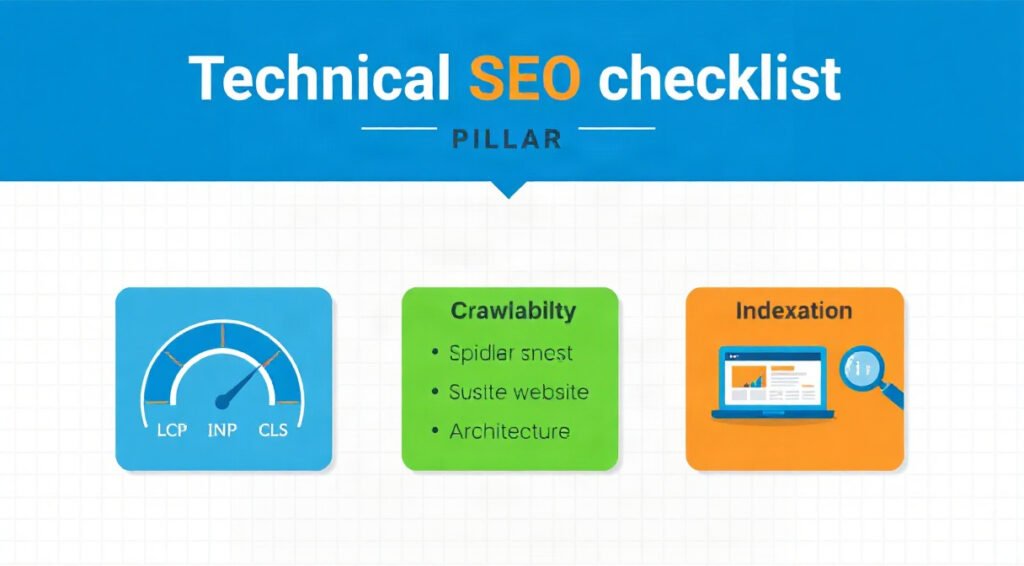
Technical SEO remains the foundation of every successful digital marketing strategy in 2026. While content quality and backlinks grab headlines, search engines cannot rank what they cannot find, crawl, or render properly. This comprehensive technical SEO checklist delivers 15 essential steps that solve the most critical website performance issues holding your rankings hostage.
Whether you’re managing enterprise-scale platforms or growing small business websites, implementing these Core Web Vitals optimization tips alongside crawlability and indexation fixes creates the technical infrastructure Google rewards with higher visibility. Search engines have evolved dramatically—these aren’t optional improvements anymore. They’re survival requirements.
Why Technical SEO Dominates 2026 Search Rankings
Google’s algorithm updates increasingly prioritize user experience signals derived from technical performance. The March 2024 Core Update and subsequent Helpful Content refinements made one truth undeniable: websites with poor technical foundations cannot compete regardless of content quality.
Consider these critical 2026 statistics:
- Pages loading in under 2.5 seconds achieve 3x higher conversion rates
- 53% of mobile users abandon sites taking longer than 3 seconds to load
- Websites passing all Core Web Vitals thresholds see 24% average organic traffic increases
- Crawl budget waste from technical errors costs enterprise sites millions in lost visibility
This technical SEO checklist addresses every critical checkpoint—from server configuration to JavaScript rendering—ensuring search engines access, understand, and prioritize your content effectively.
Core Web Vitals: The Performance Foundation
Google’s Core Web Vitals have matured from experimental metrics to ranking necessities. These three measurements now directly influence your search positions, making Core Web Vitals optimization tips essential knowledge for every SEO professional.
Understanding the Three Core Metrics
Largest Contentful Paint (LCP): Measures loading performance. Your main content must render within 2.5 seconds. Exceed 4 seconds and you fail the assessment, triggering ranking penalties.
First Input Delay (FID) → Interaction to Next Paint (INP): March 2024 replaced FID with INP, measuring responsiveness throughout the entire page lifecycle—not just initial load. Scores under 200 milliseconds pass; anything above 500 milliseconds fails.
Cumulative Layout Shift (CLS): Quantifies visual stability. Elements shifting during load create frustrating user experiences. Maintain scores below 0.1 for optimal performance.
Advanced Core Web Vitals Optimization Tips
Implement these proven Core Web Vitals optimization tips to transform your performance scores:
1. Implement Critical CSS Inline Loading
Extract and inline CSS required for above-the-fold content. Defer non-critical stylesheets using rel="preload" and onload="this.rel='stylesheet'" attributes. This eliminates render-blocking resources that devastate LCP scores.
2. Leverage Modern Image Formats
Convert all images to WebP with AVIF fallback. Implement responsive images using sizes and srcset attributes. Lazy-load below-fold images natively with loading="lazy". These changes alone typically improve LCP by 40-60%.
3. Optimize Font Loading Strategies
Use font-display: swap to prevent invisible text during load. Subset fonts to include only necessary characters. Preload critical fonts with <link rel="preload"> in your document head.
4. Minimize JavaScript Execution Time
Long tasks blocking the main thread destroy INP scores. Split bundles, implement code splitting, and leverage web workers for heavy computations. Consider partial hydration for complex interactive components.
5. Reserve Space for Dynamic Content
Specify exact dimensions for images, videos, and embeds. Use aspect ratio boxes for responsive containers. These practices eliminate layout shifts that inflate CLS scores.
Crawlability: Removing Search Engine Barriers
Search engines must discover your content before ranking it. Crawlability issues silently destroy visibility by preventing bot access to valuable pages. This section of your technical SEO checklist eliminates the most common discovery obstacles.
Server and Infrastructure Essentials
Ensure Consistent Server Availability
Monitor uptime aggressively. Even brief outages during crawl windows waste crawl budget and signal unreliability. Implement redundant hosting, CDN failover, and real-time alerting through tools like Pingdom or UptimeRobot.
Optimize Response Codes
Return proper HTTP status codes. 200 OK for valid pages, 301 for permanent redirects, 404 for genuinely removed content, and 410 for intentionally deleted resources. Avoid soft 404s—pages returning 200 status with “not found” messaging confuse crawlers and waste indexation resources.
Implement Log File Analysis
Server logs reveal actual crawler behavior. Identify orphan pages, crawl traps, and wasted budget on low-value URLs. Tools like Screaming Frog Log Analyzer or Botify transform raw logs into actionable intelligence.
Robots.txt and Meta Robots Configuration
Your robots.txt file serves as the first gatekeeper. Common 2026 mistakes include:
- Blocking CSS, JavaScript, or image files that support rendering
- Using disallow directives when noindex tags would prevent indexation without blocking discovery
- Failing to submit updated robots.txt through Google Search Console after changes
- Creating overly broad rules that accidentally block important content sections
Meta robots tags offer granular control. Use noindex, follow for pages you want crawled but not indexed—like paginated results or filtered category pages. Reserve noindex, nofollow for truly private content.
JavaScript Rendering and Dynamic Content
Modern web applications increasingly rely on JavaScript frameworks. Google’s rendering capabilities improved dramatically, but challenges persist:
Server-Side Rendering (SSR) Implementation
Frameworks like Next.js, Nuxt, and Angular Universal deliver fully rendered HTML to crawlers. This eliminates JavaScript dependency for initial content discovery and dramatically improves crawl efficiency.
Dynamic Rendering as Fallback
For complex applications where SSR isn’t feasible, dynamic rendering serves prerendered versions to search bots while maintaining rich experiences for users. Tools like Prerender.io or Rendertron automate this process.
Progressive Enhancement Principles
Build core content and navigation in semantic HTML. Layer JavaScript enhancements progressively. This ensures accessibility and crawlability regardless of execution environment.
Indexation: Controlling What Appears in Search
Crawlability enables discovery; indexation determines visibility. This technical SEO checklist section focuses on ensuring search engines index your valuable content while excluding duplicates and low-quality pages.
Canonicalization and Duplicate Content
Duplicate content fragments ranking signals and confuses search algorithms. Implement these protections:
Self-Referencing Canonical Tags
Every indexable page should include <link rel="canonical" href="https://example.com/page/"> pointing to its preferred URL. This consolidates signals when parameters, tracking codes, or session IDs create URL variations.
Parameter Handling in Search Console
Configure URL parameter tools to indicate how Google should treat tracking parameters, sort orders, and filter combinations. Prevent unnecessary crawling of near-duplicate pages generated by faceted navigation.
hreflang Implementation for International Sites
Multi-regional websites require precise language targeting. Implement hreflang tags in XML sitemaps or HTML headers, ensuring reciprocal references between all language variants. Validate implementation through Google’s hreflang testing tool.
XML Sitemap Optimization
Your XML sitemap guides crawler priority. Modern best practices include:
- Segment sitemaps by content type (products, articles, videos, images)
- Include
<lastmod>dates updated only when content actually changes - Prioritize high-value pages through strategic ordering
- Implement sitemap index files when exceeding 50,000 URLs or 50MB
- Submit sitemaps through both Google Search Console and robots.txt reference
Internal Link Architecture
Strategic internal linking distributes authority and establishes content relationships. Your technical SEO checklist must include:
Click-Depth Optimization
Ensure important content resides within three clicks from homepage. Deeply buried pages receive minimal crawl frequency and ranking authority. Implement breadcrumb navigation and contextual cross-linking to reduce depth.
Anchor Text Diversity
Vary anchor text naturally while maintaining descriptive relevance. Avoid exact-match over-optimization that triggers spam filters. Use surrounding content to reinforce topical relationships.
Orphan Page Elimination
Pages without internal links depend entirely on sitemap inclusion and external references. Audit regularly to identify and connect valuable orphan content. Remove or noindex true orphans lacking strategic value.
Mobile-First Technical Excellence
Google’s mobile-first indexing completed rollout in 2023, making mobile performance your primary ranking consideration. These technical requirements now apply to all devices:
Responsive Design Implementation
Flexible grids, fluid images, and media queries ensure optimal rendering across viewport sizes. Avoid separate mobile URLs that fragment authority and complicate maintenance. Google’s mobile-friendly test validates basic compatibility.
Touch Target Optimization
Interactive elements require minimum 48×48 CSS pixels of touch target space. Prevent accidental taps that frustrate users and increase bounce rates. Space adjacent targets appropriately.
Viewport Configuration
Include proper viewport meta tags: <meta name="viewport" content="width=device-width, initial-scale=1">. Prevent user scaling restrictions that impair accessibility and violate mobile usability guidelines.
Mobile Performance Budgets
3G connections remain common globally. Establish performance budgets limiting page weight, request counts, and JavaScript execution. Test on actual devices, not merely emulators, to validate real-world experience.
Structured Data and Rich Results
Schema markup transforms how search engines interpret and display your content. Implementation in 2026 requires precision:
JSON-LD as Preferred Format
Google recommends JSON-LD for its separation of structured data from visible content. Implement in <script> tags within document head or body, avoiding inline microdata or RDFa when possible.
Critical Schema Types by Industry
- E-commerce: Product, Offer, AggregateRating, FAQPage
- Publishers: Article, NewsArticle, Author, Review
- Local businesses: LocalBusiness, OpeningHoursSpecification, GeoCoordinates
- Events: Event, Offer, Organization
- Recipes: Recipe, AggregateRating, NutritionInformation
Validation and Monitoring
Test all markup through Google’s Rich Results Test and Schema.org validator. Monitor Search Console enhancement reports for errors and warnings. Structured data issues now trigger manual actions, making ongoing compliance essential.
Security and HTTPS Implementation
HTTPS has been a ranking signal since 2014, but 2026 requirements extend beyond basic certificate installation:
Certificate Configuration
Implement valid, unexpired certificates from trusted authorities. Enable HTTP/2 or HTTP/3 for multiplexed, encrypted connections. Configure HSTS headers to prevent downgrade attacks and improve performance through connection reuse.
Mixed Content Elimination
Audit for resources loaded over HTTP on HTTPS pages. Modern browsers block or warn on mixed content, degrading user experience and security indicators. Implement content security policies to prevent future occurrences.
Security Headers
Deploy comprehensive protection: X-Frame-Options, X-Content-Type-Options, Referrer-Policy, and Permissions-Policy. These headers prevent common attack vectors and demonstrate security commitment to search engines.
Site Speed and Performance Engineering
Beyond Core Web Vitals, holistic performance optimization delivers competitive advantages:
Content Delivery Network Deployment
CDNs reduce latency through geographic distribution. Configure proper cache headers, enable Brotli compression, and implement edge computing for dynamic personalization without origin server hits.
Resource Hint Implementation
Guide browser optimization through resource hints: dns-prefetch for external domains, preconnect for critical third-party resources, prefetch for likely next navigation, and prerender for high-confidence predictions.
Database and Query Optimization
Application performance directly impacts TTFB (Time to First Byte). Optimize database queries, implement object caching, and consider edge database solutions like Cloudflare D1 or PlanetScale for global performance.
Technical SEO Monitoring and Maintenance
Technical excellence requires ongoing vigilance. Establish these monitoring practices:
Automated Crawl Monitoring
Schedule weekly crawls using Screaming Frog, Sitebulb, or Deepcrawl. Track technical health scores over time, alerting on new errors, redirect chains, or performance degradation.
Search Console Integration
Monitor Core Web Vitals reports, page experience signals, and coverage status. Address validation fixes promptly. Use URL inspection tool for real-time indexing troubleshooting.
Performance Budget Enforcement
Implement CI/CD checks that fail builds exceeding performance thresholds. Tools like Lighthouse CI and WebPageTest API automation prevent regression.
For comprehensive automation strategies that maintain technical excellence at scale, explore our AI-powered SEO automation resources.
Frequently Asked Questions
How often should I run a technical SEO checklist audit?
Execute comprehensive technical SEO checklist audits quarterly, with automated monitoring for critical issues weekly. Major website changes—migrations, redesigns, platform updates—require immediate pre and post-launch audits. Enterprise sites with frequent deployments should implement continuous monitoring through automated crawling tools that alert on new errors within 24 hours.
What’s the fastest way to improve Core Web Vitals scores?
Image optimization delivers immediate impact with minimal development effort. Convert to WebP/AVIF, implement responsive sizing, and enable lazy loading—these three Core Web Vitals optimization tips typically improve LCP by 40-60% within days. Follow with font loading optimization and JavaScript code splitting for INP improvements. Server response time reductions through caching and CDN implementation provide foundational gains supporting all metrics.
How do I fix crawl budget waste on large websites?
Start with log file analysis identifying low-value pages consuming disproportionate crawler attention. Consolidate near-duplicate content through canonicalization or parameter handling. Eliminate orphan pages and infinite crawl traps from faceted navigation. Improve internal linking to ensure important content receives appropriate crawl priority. Finally, robots.txt strategically blocks truly non-essential resources while preserving discovery pathways to valuable content.
Should I prioritize mobile or desktop technical SEO?
Mobile-first indexing makes mobile performance your primary concern—Google predominantly crawls and evaluates mobile versions. However, maintain desktop excellence as significant traffic and conversion volume often originates from desktop users, particularly in B2B contexts. Implement responsive design ensuring optimal experiences across all devices rather than creating separate optimization tracks.
What technical SEO issues cause immediate ranking drops?
Severe server outages, accidental noindex implementations, robots.txt blocking critical sections, and canonical errors pointing all versions to non-existent URLs cause dramatic visibility losses. HTTPS certificate expiration, malware infections triggering safe browsing warnings, and manual actions from structured data spam also create immediate impacts. Implement monitoring alerts for all these failure modes with escalation procedures ensuring rapid response.
How does AI impact technical SEO requirements in 2026?
AI-generated content saturation increases importance of technical differentiation—search engines rely more heavily on structured data, entity relationships, and performance signals to evaluate quality. AI-powered crawling and rendering means JavaScript-heavy applications face fewer limitations, but also raises expectations for sophisticated interactivity. Implement AI-assisted monitoring tools that predict technical issues before they impact rankings, and leverage natural language processing for enhanced internal linking and content structure optimization.
Conclusion: Building Technical Excellence That Lasts
Technical SEO in 2026 demands sophisticated understanding of how search engines discover, render, evaluate, and rank content. This technical SEO checklist provides the systematic framework transforming websites from invisible to indispensable in search results.
The intersection of Core Web Vitals optimization tips, crawlability engineering, and indexation control creates sustainable competitive advantages. While competitors chase algorithm updates, technically sound websites capture consistent visibility through operational excellence.
Implementation priority matters. Address critical errors blocking crawl access first, then optimize Core Web Vitals for user experience signals, finally layering advanced structured data and performance enhancements. This progression delivers measurable improvements at each stage while building toward comprehensive technical dominance.
Ready to transform your technical foundation into search engine success? Seelaunch LLC specializes in AI-powered technical SEO automation that implements these strategies at scale, monitoring continuously, and optimizing relentlessly. Let’s build the technical infrastructure your content deserves.
Sources: Google Search Central Documentation, Chrome User Experience Report, HTTP Archive, and Search Engine Journal technical SEO research.